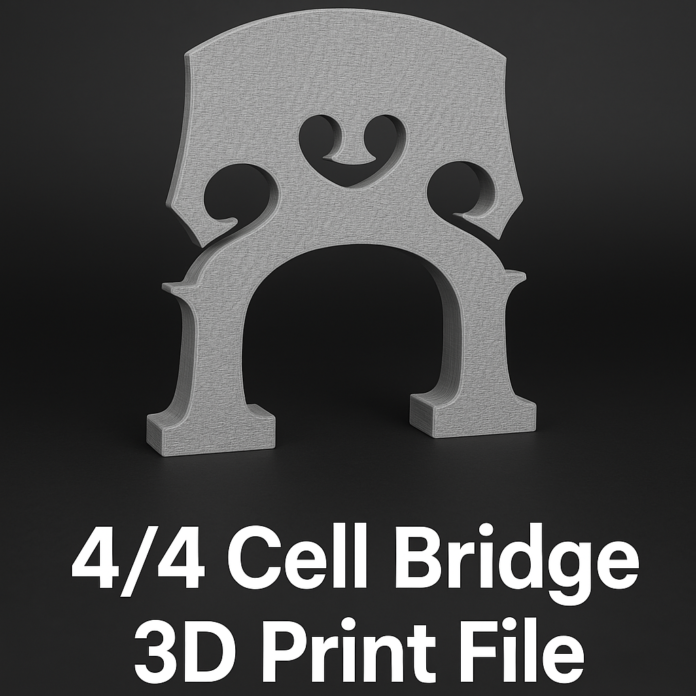

4/4 cell bridge Among the most thrilling recent developments in 3D printing, which is changing music, is the 3D print file. From a luthier wanting to prototype fast to a violinist looking for a backup option, 3D-printed bridges could provide an unexpected use. This article covers how to locate, utilize, and improve a 3D print file for a 4/4 cello bridge. We’ll discuss where to locate dependable models, how to print them fast, and how they stack up against conventional wooden bridges.
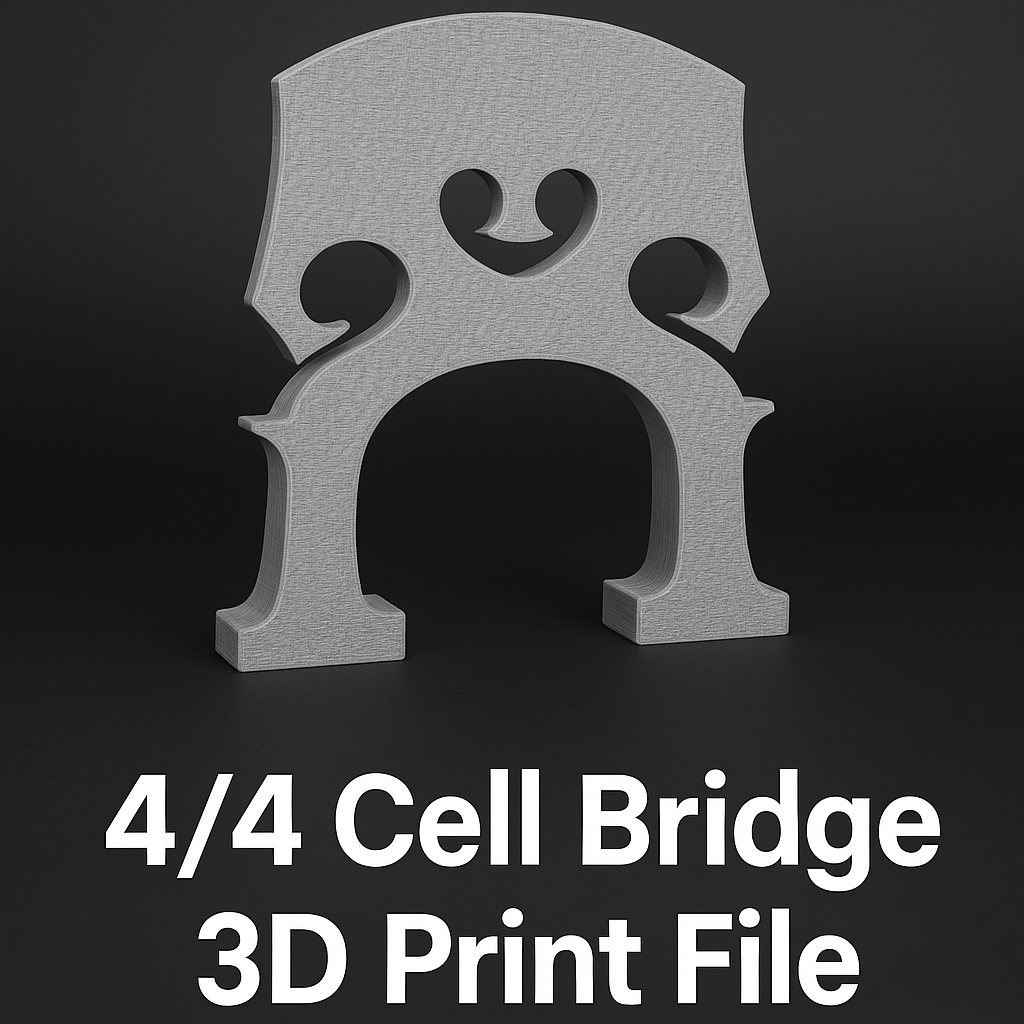
A full-size bridge
The 4/4 cello bridge is meant to support the strings on a full-sized cello. The strings on a full-sized cello are supported by a full-size bridge known as a 4/4 cello bridge. Playing a key role in tone quality and resonance, it transmits vibrations from the strings to the instrument’s body.
Although bridges are sometimes made from maple wood, 3D printing provides a quick, affordable method to test new concepts or produce emergency backups.
What are the Advantages of a 3D Printed Cello Bridge?
Though now the gold standard, wooden bridges have several interesting benefits compared to 3D printed ones:
- Economic Efficiency: Prototyping requires no costly tonewood or hand-carving time.
- Personalization: Bridge height, arch design, and string spacing can all be adjusted to suit particular playing techniques. Instant access to a bridge design for informative models or emergency replacements.
- Creativity: Engineers and designers may examine anomalous material acoustic behavior.
Where to Look for a 4/4 Cell Bridge 3D Print File
Many trustworthy sites provide 3D print files—typically in STL format—for cello bridges:
- Thingiverse: Look up “4/4 cello bridge”.
- MyMiniFactory has more artistically designed products.
- Printables: Increasing collection based on user input; always verify each file’s licensing. Most are for non-commercial usage only unless otherwise stated.
Best Materials to Print a Cello Bridge
Whether the bridge has enough strength and sound transfer capability depends on your choice of filament or resin.
FDM Manufacturing
- Easy to print and robust enough for non-performance use.
- More durable and flexible; more suitable for tension distribution: PLA+, PETG.
Resin Printing
- Tough Resin: Provides great strength and superb tonal qualities.
- Design: For structural uses, resin is ideal.
3D printed bridges are suitable for practice, experimentation, or as a backup. Hand-carved wood will still be preferred by serious performers.
Printing Advice for a Functional Bridge
- Print with 100% Infill: To be strong under string pressure.
- Layer height of 0.1 mm: Increases the detail of fine features.
- The Importance of Orientation: Print the bridge vertically to reinforce along the grain direction.
- Post-processing: Check string notch depth and gently smooth edges before use.
Actual Use Cases
- Schools of Music: Using printed bridges to educate pupils on configuration and modifications.
- Luthiers: Before investing in costly tonewood, rapidly prototype many ideas.
- Beginners: Think about creating your own instrument accessories or bespoke bridge profiles.
- Replacement in an emergency: Keep a couple of printed bridges in your case as spares.
Employing SEO Keywords & Synonyms
Promoting your blog, Etsy store, or bridge prints? Use words like:
- Four four-cell bridge
- 3D printed file
- Cellular bridge
- STL 3D printed cello parts
- Lithograph of a cello and violin bridge
- 3D model of instrument bridge
- 4/4 Cell Bridge 3D Print Files
READ MORE – 3D Resin Printing in Idaho Falls: Everything You Need to Know
FAQs:
- Would a 3D-printed cello bridge work for live performance?
Not usually. While wood bridges are less lasting and have more tone, they might be useful in practice or emergencies. - Which filament will let me print a cello bridge?
For FDM printers, use PETG or PLA+; for SLA printers, use strong resin. - Will printing a cello bridge require supports?
Usually not, particularly if printed vertically. Under arch regions, few supports could be required. - May I alter the design of the bridge?
Certainly. Change height, arch, or string slots using Fusion 360 or TinkerCAD, among other CAD programs. - Can 3D-printed cello bridges lawfully be sold?
Yes, assuming the STL file falls within a commercial-use license. Always respect the designer’s rights of use.
Conclusion:
For musicians, teachers, and artists, the existence of a 4/4 cell bridge 3D print file presents interesting opportunities. A 3D-printed cello bridge could be a useful tool whether you’re looking into new ideas, educating students about instrument setup, or just need a quick repair.
Your work may help shape the changing future of digital art in music by means of research, printing, modification, and distribution.